Yves here. Most accept that algorithmic curating works in manipulating political and even broader cultural views. One could argue that Facebook would not have a business if it didn’t. But what is the mechanism by with the algorithm has that effect? For instance, I have a generally bright, highly analytical, extremely well informed contact who nevertheless pickles his brain all day by having Fox on in the background while working. It is striking how he has swallowed right wing tropes, like the US is suffering from a big crime wave. So (admittedly from anecdata) one might conclude that immersion does the trick.
This article finds a more complicated but similar mechanism: that being subjected to algorithm-driven news feeds on right wing Twitter does lead to a move to more right wing positions, but not just by virtue of the time of consumption them. Being on the receiving end of algorithm-skewed content leads the customer to follow ideologically-aligned feeds and sites, thus perpetuating the information skew after the time of indoctrination.
By Germain Gauthier, Assistant Professor Bocconi University, Roland Hodler, Professor of Economics University Of St Gallen, Philine Widmer Assistant Professor Paris School of Economics, and Ekaterina Zhuravskaya, Professor of Economics Paris School of Economics. Originally published at VoxEU
Algorithms curate what users of social media see, raising concerns that they may distort attitudes and affect social and political outcomes. This column reports on an experiment conducted on X in the US in 2023, in which users were randomly assigned to either an algorithmic or a chronological feed. Switching from a chronological to an algorithmic feed significantly shifted political opinions in a pro-Republican direction, while switching the algorithm off had no comparable effect. This asymmetry arose because the algorithm affected which accounts users chose to follow, leaving a lasting imprint on their information environment even after algorithmic curation was removed.
With the advent of feed algorithms, social media streams are no longer simple time-ordered lists of posts from accounts users follow. Instead, algorithms curate what users see by inserting posts from accounts they do not follow and reshuffling the order of content, which can push down and, as a result, effectively hide posts from followed accounts. Algorithms curate personalised feeds primarily to maximise users’ engagement with the platform and potentially also for other purposes. Concerns that social media algorithms may distort attitudes and affect social and political outcomes are widespread (e.g. Pariser 2011, Settle 2018, Sunstein 2018, Persily and Tucker 2020, Rose-Stockwell 2023, Braghieri et al. 2025). These algorithms may promote content that grabs users’ attention, such as extreme and toxic posts. They also may prioritise posts that reinforce users’ existing beliefs and misconceptions, contributing to the creation of polarised information environments, so-called filter bubbles.
Yet, surprisingly, prior large-scale rigorous experiments found that political attitudes were unaffected by switching the feed algorithms off (Guess et al. 2023). In particular, a study conducted with Meta during the 2020 US election showed that replacing users’ feed from an algorithmically curated one to a chronological one changed what users saw on their feeds, decreased their engagement, but did not measurably affect political attitudes, partisanship, or polarisation.
This finding leaves important open questions: are the commonly expressed worries about the algorithms unwarranted? Could exposure to algorithmic feeds have effects on attitudes that persist even after the algorithm is turned off, implying that there is an asymmetry in the effects of switching an algorithmic feed on versus off? Do the results generalise to other platforms? Should one expect some political attitudes to be more malleable and more easily affected by the algorithm than others in highly polarised and partisan environments?
The Experiment
In a new paper (Gauthier et al. 2026), we present the results from an experiment we conducted on X (formerly Twitter) in the summer of 2023. X offered a rare opportunity for studying feed algorithms without platform cooperation. Users could choose between two feeds: a chronological feed (‘Following’ tab) that showed posts from accounts users followed in reverse chronological order, and an algorithmic feed (‘For you’ tab) that both reordered content and added posts from accounts users did not follow. We recruited about 5,000 active X users, randomly assigned them to either the algorithmic or the chronological feed, and paid them to stay on their assigned feed setting for seven weeks.
Some participants were thus required to switch feed settings, while others kept their previously used feed setting. This design allowed us to study two distinct treatments: switching the algorithm on for users who had previously relied on a chronological feed, and switching it off for users who had previously used the algorithmic feed. We measured the effects of this intervention on user engagement, political views, and choices of which accounts to follow.
Switching the Algorithm on Moved Opinions Toward the Right; Switching It Off Had No Effect
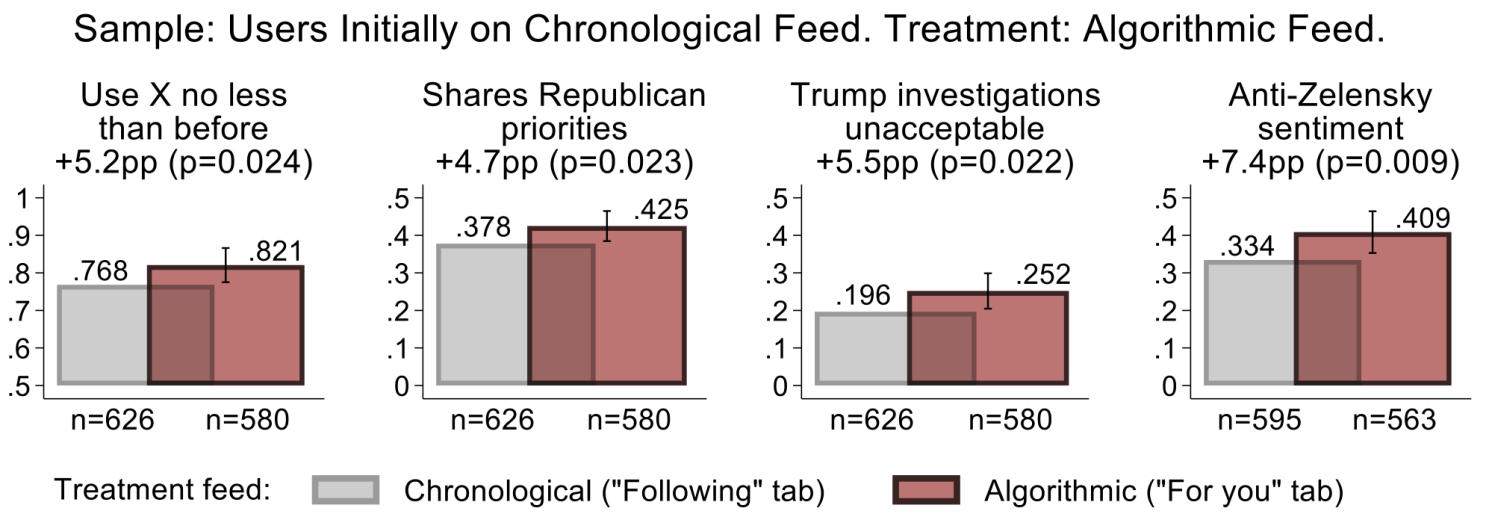
First, as one would expect, because the algorithm maximises engagement, users who were switched from the chronological to the algorithmic feed spent more time on X compared to those who remained on the chronological feed. Our second finding is new compared to prior literature: the political attitudes were strongly and significantly affected by switching the algorithm on. Exposure to the algorithmic feed shifted users’ political views in a pro-Republican direction. After seven weeks of experiment-induced exposure to the algorithmic feed, these users were more likely to prioritise policy issues typically emphasised by Republicans, such as inflation, immigration, and crime, over policy issues typically emphasised by Democrats, such as healthcare and education, compared to users who stayed on the chronological feed.
They were also, on average, more inclined to consider criminal investigations into Donald Trump unacceptable, viewing them as undermining democracy and the rule of law. They were also more likely to take a pro-Kremlin stance regarding Russia’s invasion of Ukraine and express negative sentiments towards Ukrainian leadership and Joe Biden’s support of Ukraine. We illustrate some of these effects with selected outcomes in panel (a) of Figure 1.
Figure 1 Effects of switching the algorithm on and off on engagement and selected political attitudes
(a) Users initially on chronological feed switched to algorithmic feed
(b) Users initially on algorithmic feed switched to chronological feed
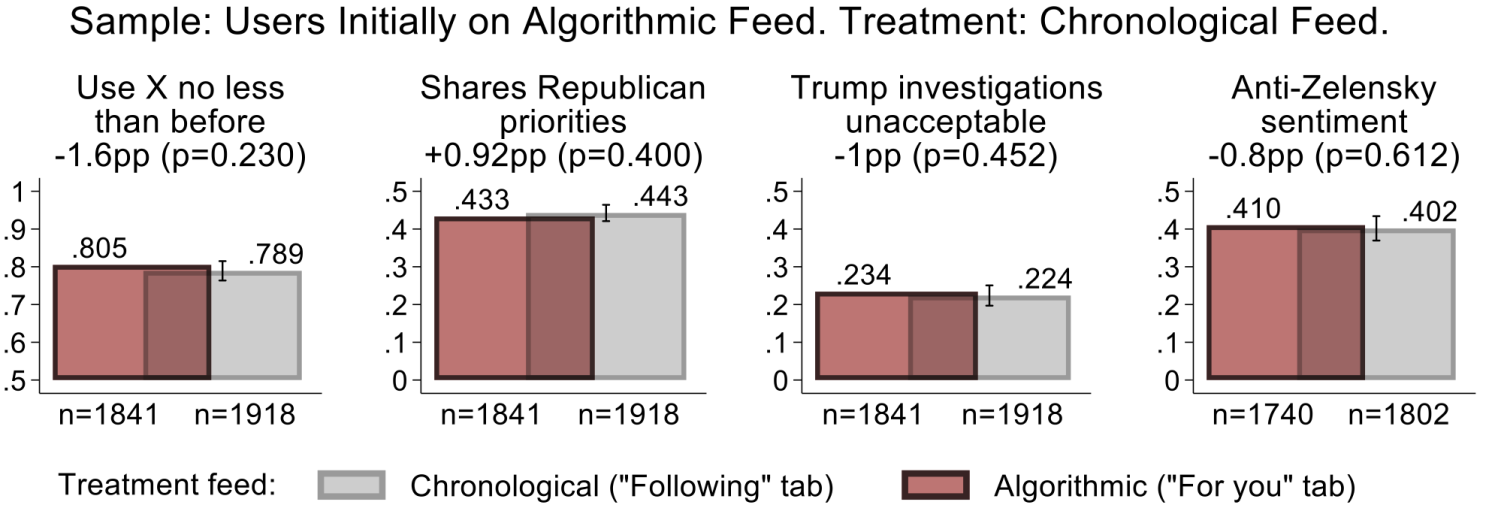
Notes: Selected attitudinal outcomes. Panel (a) shows the effects of switching users from the chronological to the algorithmic feed; panel (b) shows the effects of switching users from the algorithmic to the chronological feed. Bars show mean survey outcomes (engagement with X, policy priorities, opinions about investigations into Donald Trump, and sentiments towards the Ukrainian President Volodymyr Zelenskyy and investigations into US President Donald Trump) after seven weeks of assigned feed exposure, grouped by users’ initial feed (panels a and b) and by treatment feed (grey and red bars). 95% confidence intervals reported. For details, see Gauthier et al. (2026).
Source: Gauthier et al. (2026).
These results are driven by effects among users who self-reported as Republican or Independent in the pre-treatment survey, consistent with a common finding in the persuasion literature that persuasion is most effective for positively predisposed audiences (e.g. Adena et al. 2015).
Equally striking is what we do not find. First, switching users from the algorithmic feed to the chronological feed had essentially no effect on political attitudes (Figure 1, panel (b)). This is fully consistent with the Meta study (Guess et al. 2023) and suggests general validity of the findings in both Meta and our experiments.
Second, we found no effect on self-reported partisanship or polarisation for either switching the algorithm on or off. This suggests that algorithms may change views on current policy issues and policy priorities, but not users’ more rigid partisan identity.
How Algorithms Leave a Lasting Footprint
At first glance, the asymmetry of the effects of switching the algorithm on and off on political attitudes is puzzling. If algorithmic curation pushes opinions in one direction, why does removing it not reverse those effects? The answer lies in how the algorithm shapes users’ behaviour.
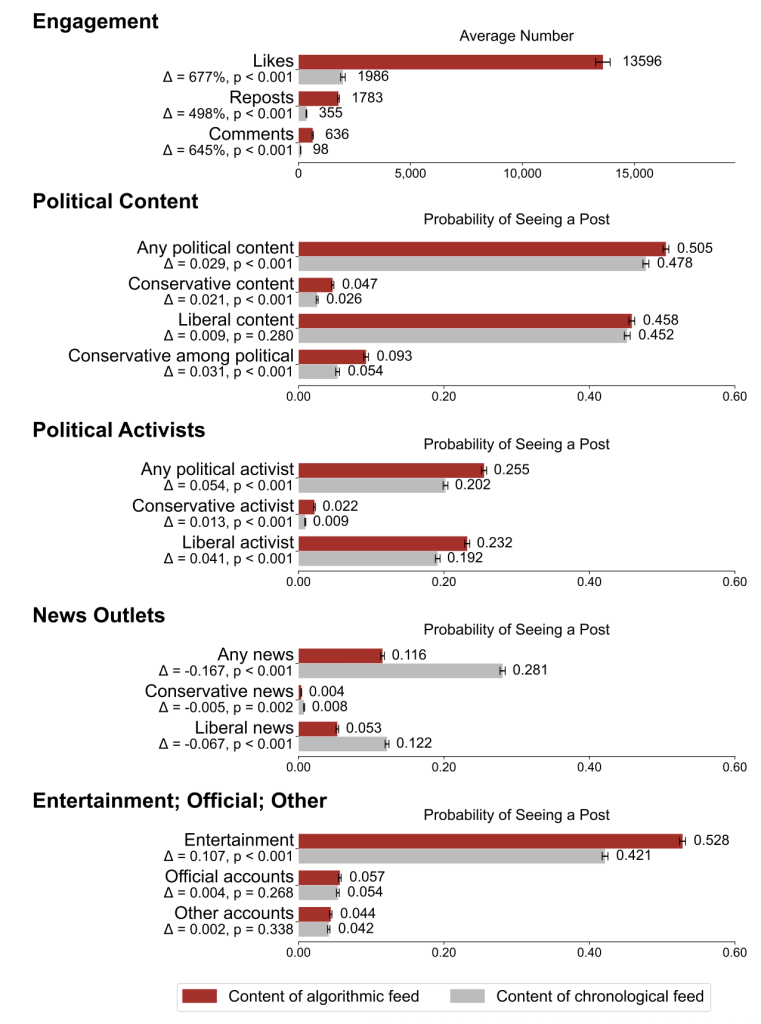
To understand the mechanism, we analysed both the content shown to users on their feed and the accounts they chose to follow. First, we asked users to run a purpose-built Google Chrome extension that downloaded the content of their feeds under both feed settings. These data provided direct evidence of what the X algorithm promoted in the summer of 2023. Compared with the chronological feed, the algorithmic feed showed many more posts that had already generated high engagement (likes, comments, and reposts).
With regard to politics, the algorithmic feed had a significantly higher share of political content, and within that, it prioritised right-wing content much more than left-wing content. It showed significantly more posts from political activists (defined as regular users who post a lot about politics and who could not be classified as media, governments, or organisations), both on the right and on the left, but showed fewer posts from traditional news outlets, also both on the right and on the left. Even though we found substantial heterogeneity in the share of right-wing content in the feeds of Republican-leaning and Democrat-leaning users, the share of right-wing content among all political content was significantly higher for both groups of users. We illustrate which content the algorithm promotes in Figure 2. (The content differences between chronological and algorithmic feed settings are the same irrespective of whether we include user fixed effects.)
Figure 2 What the algorithm promotes, by self-declared partisanship
(a) Democrats
(b) Republicans and Independents
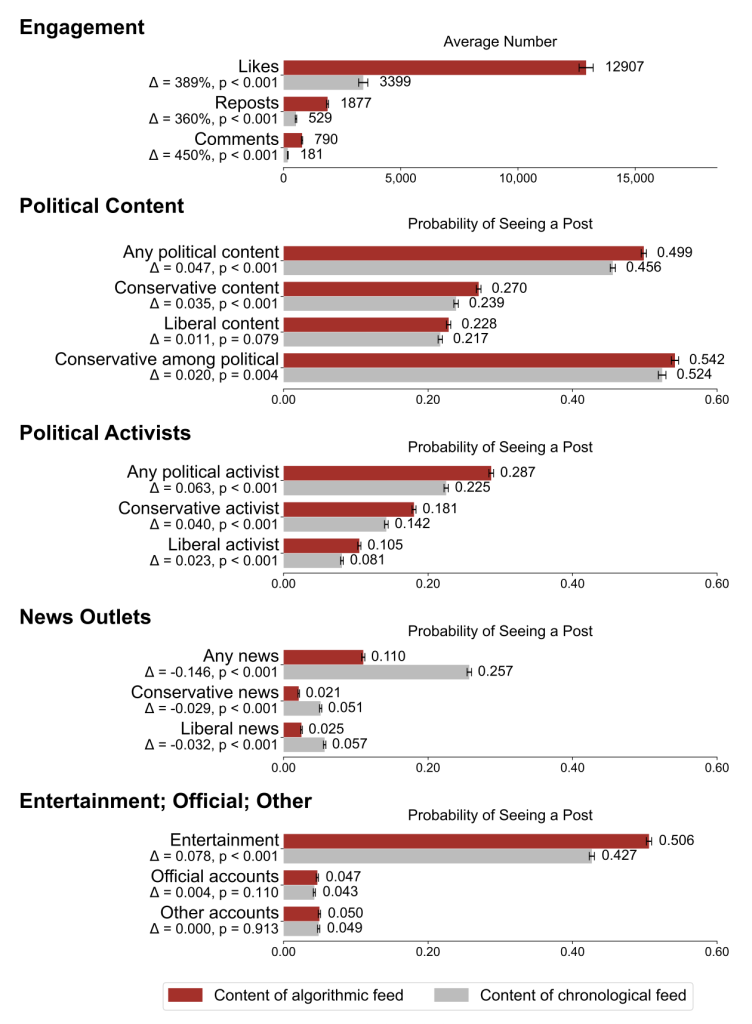
Notes: Content of feeds, by self-declared partisanship. Average content shown to users in each feed setting: the chronological feed (grey) and the algorithmic feed (red). 95% confidence intervals reported. For details, see Gauthier et al. (2026).
Source: Gauthier et al. (2026).
Second, we find that exposure to the algorithm changes which accounts users chose to follow. Users who switched to the algorithmic feed become more likely to follow political activist accounts, especially right-wing activists. In contrast, we do not see changes in the followed accounts for users who switched to the chronological feed. This explains the asymmetry in effects. It implies that the algorithm nudges users toward new sources, and users continue to follow them even after the algorithm is switched off (i.e. users do not actively unfollow those accounts). The influence of these sources thus persists even when the algorithmic feed is switched off.
Implications for Policy and Platform Design
These results carry important implications for the debate about regulating social media algorithms.
Our results strongly suggest that social media feed algorithms are not politically neutral. They can influence what people believe, and those effects may last longer than the algorithm itself because they affect users’ online behaviour and, more notably, the choice of followed accounts. This calls for a serious discussion about the regulation of feed algorithms.
Furthermore, our findings highlight that algorithms can shape political attitudes without increasing self-reported partisan polarisation or changing partisan identity, at least not in the short run. This challenges the common tendency to equate political influence solely with polarisation. Subtle shifts in issue priorities and beliefs about current events may be just as consequential for democratic outcomes. Further, if people use these platforms over years, one cannot rule out that influence on such priorities and beliefs accumulates over time and eventually also changes more deeply held political identities.
Finally, our study underscores the importance of studying platforms independently and in real-world settings. As algorithms, content, and user behaviour may evolve rapidly, and their effects depend on platform-specific design choices and incentives, a systematic monitoring of social media algorithms is needed (Aridor et al. 2025).
See original post for references


Interesting. Thanks for this. So, a claim for what has been called “cultivation theory” though I thought that after six decades of research the consensus on media effects has been that… there is no consensus (e.g., see the argument in David Gauntlett’s Moving Experiences). Is there research to indicate the situation has actually changed with the rise of social media?
Also:
… good luck with regulating these corporate behemoths, at least in the West. They will push back. Also, this is where all the age verification a.k.a. surveillance will be intensified.
Passive consumption of news, reliance on a single source or point of view (inevitably or eventually the one you agree with) is bad mental hygiene.
When I want work done on my house I ask neighbors for referrals, check out the BBB, etc. If it’s expensive, I talk to multiple potential providers. What I never do is hire someone who knocks on my door offering a service.
Spend a few minutes once in a while to sample different sources on the MSNBC/Foxnews spectrum. What strikes me is not that they provide differing takes on the same items, but the lack of overlap in stories aired. News curation introduces bias in what it doesn’t present as well as in what it does.
I don’t X and I barely watch television any more other than PBS which itself has gone downhill. We Boomers grew up surrounded by a vast stew of the propaganda called advertising and some of us developed an allergic reaction to all the manipulation. Meanwhile Vietnam and the Cold War showed that our government is not to be trusted either. Before the internet came along I had even taken to listening to foreign shortwave broadcasts as an alternative to our MSM and their party line.
Sadly the BBC World Service–still to be heard on some NPR stations–has become alternately inane or mendacious and the shortwave alternative itself has given way to the web because operating all those transmitters was expensive.
Blogs you are our last hope although those who care to know the truth will always find some avenue. Keep up the good work!
Thanks for posting this!
I find there’s a huge disconnect between online news and just going outside IRL and experiencing what’s going on. IMO there’s like zero crime except from the rich pedo elite stealing our children and resources. I am seeing pushback on Twitter, Facebook, Tik Tok, etc against these Divide And Conquer Identity Politics tactics by the Rich Pedos which is why I think they will poison online with AI and try to scapegoat the government.
During Coronavirus I was working outside Portland and all my friends and family were texting me about riots and staying safe. I’m like uhhhh WTF ARE YOU TALKING ABOUT???
Online is full of fear and isolation.
Outside is full of love and community.
ONLINE IS FAKE AF*
More and more of my neighbors are getting political and I’m pushing hard for another American Revolution. We the people demand Justice for these rich pedo fucks trying to exterminate us.
THE SLEEPER HAS AWAKENED
*Except NC, where y’all actually tell the truth.
Not as interesting an analysis as it could have been. I don’t think I would have chosen “anti-Zelensky” or “anti-Trump-investigation” as my markers in 2023 with equanimity. Simply knowing more accurate detail on those two issues was likely to move an otherwise neutral Everyman “toward the Right”. These were both issues in 2023 which both leftish activists and legacy news media tended to present in cartoonish moral narrative scripts, heavy with prejudicial abstract labels and light on concrete details.
A key element in other analyses of the impact of social media use is the effect on memory. People who knew nothing about Ukraine in January 2022 are not likely to have the same view of Zelensky in 2023 as people who, for whatever reason, had a base of knowledge already. Does social media leverage memory or erase it? Did users enrich their views or simply trade in one stock of views for another?
I would like to know if users learn anything — either actual detail or detailed facts that aren’t so. Could a user identify the legal argument for the “39 felonies”, for example, in the case of Trump investigations?
Personal disclosure: I recently deleted my X-twitter account, because it was sucking up too much time and attention. Now, Substack sucks up too much time and attention! So, no net gain for me. The thing I found personally disturbing in X-twitter feeds post-Musk was the featuring of explicit racism in, say, clips of migrant crime in Europe. That is a categorically different kind of “right-wing view” from the he-said-she-said FoxNewsMSNow partisan polarization that cheers for anyone wearing the correct team jersey.