Category Archives: Income disparity

Matt Stoller: The Liquidation of Society versus the Global Labor Revival

By Matt Stoller, a fellow at the Roosevelt Institute. His Twitter feed is http://www.twitter.com/matthewstoller.

Today, the city of Providence, Rhode Island sent out layoff notices to every single teacher in the city. Every single one of them. If you want to understand why this is happening, why wages in the US keep getting cut, this chart tells the story.
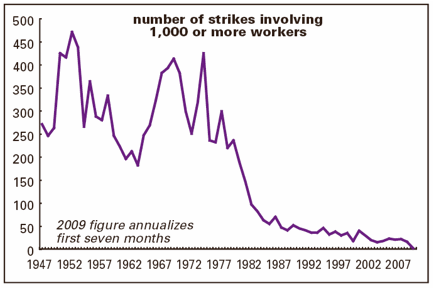
That’s the number of strikes since 1947. What you’ll notice is that people in America just don’t strike anymore. Why? Well, their jobs have been shipped off to factory countries, their unions have been broken, and their salaries until recently have been supplemented by credit. It’s part of a giant labor arbitrage game, that the Federal Reserve and elites in both parties are happy to play. Strike, and you’re fired. Don’t strike, and your pay is probably going to be cut. Don’t like it? Sorry, we can open a plant abroad. And we have institutions, like the IMF, to make sure that we get goods from those factory-countries, and get them cheap.

Read more...

Guest Post: Cooking up trouble – Soaring food and fuel prices in North Africa and the Middle East

Yves here. I thought this post was useful not only in describing how high food prices posed a particularly difficult policy problem for North African countries, but also in providing important background.

By Ronald Albers and Marga Peeters; cross posted from VoxEU.

World food prices are now even higher than their peak just before the global crisis. During periods of high commodity prices, North African and Middle Eastern governments have a long tradition of subsidising food and fuel products. But this column shows that food price inflation and consequently subsidies were also high during periods when global commodity prices were falling. Now these countries have an opportunity to correct this.

Read more...

Consumer Stress Continues to Rise While DC Goes into “Mission Enough Accomplished” Mode

The officialdom has moved on to a new form of theater, namely legislative mud wrestling, which serves as a useful distraction from the failure to deliver on what ought to have been the first order of business, namely reining in the financiers. As we’ve said repeatedly, cleaning up the banking system is a necessary precursor for recovery from a serious financial crisis. Instead, whether by dumb luck or design, enough Americans have become fixated with various forms of jealousy over advantages they believe their neighbors have (whether accurate or not) that it is providing a great smokescreen for the oligarchs to continue their looting.

The fact that the economy has moved up up from a serious trough is hailed as a recovery. But to the vast majority of Americans, the talk of better times rings hollow. The top echelons are back to spending smartly, and Wall Street bonuses for 2009 and 2010 were lavish.

But even though spending economy-wide perked up in December, some question whether it was savings fatigue rather than a return of consumerism.

Read more...

SEC Expert on Why It is a Wuss at Litigation

As readers may have noticed, I grumbled over the weekend about the decision by federal prosecutors not to bring charges against Countrywide’s Angelo Mozilo. I attributed it to two causes: extreme deregulation (you can’t prosecute if virtually nothing is a crime) and timid prosecutors. A lively debate arose in comments, with our Richard Kline contending that the real reason no Big Name had been brought to justice is that a trial would make it all too evident that there were plenty of other powerful people who had committed equally heinous acts. Can’t expose how widespread corruption is, now can we?

Other readers argued the revolving door issue, which was (in essence) don’t ruffle the law firms that will be your prospective employers. I begged to differ, in that tough, effective prosecutors were magnets for new law school grads precisely because they were great training grounds. Someone who came out of those boot camps would be more valuable than a largely untested staff member at a regulatory agency.

I got this e-mail from someone who has seen the SEC from the inside:

Read more...

Guest Post: Awareness of Poverty Over Three Centuries

By Martin Ravallion, Director of the Development Research Group, World Bank. Cross posted from VoxEU

For how long have we cared about poverty? Tracing the number of references to the word “poverty” in books published since 1700, this column shows that there was marked increase between 1740 and 1790, culminating in a “Poverty Enlightenment”. Attention then faded through the 19th and 20th centuries, leaving room for the second Poverty Enlightenment in 1960 – and interest in poverty still rising.

Read more...

Matt Stoller: The Egyptian Labor Uprising Against Rubinites

By Matt Stoller, the former Senior Policy Advisor for Rep. Alan Grayson. His Twitter feed is @matthewstoller

Via Wikileaks, we learned that the son of the former President of Egypt, Gamal Mubarak, had an interesting conversation in 2009 with Senator Joe Lieberman on the banking crisis. Gamal is a key figure in the forces buffeting Egypt, global forces of labor arbitrage, torture, and financial corruption. Gamal believed that the bailouts of the banks weren’t big enough – “you need to inject even more money into the system than you have”. Gamal, a former investment banker trained at Bank of America, helped craft Egypt’s industrial policy earlier in the decade.

Our purpose is to improve Egyptians’ living standards. We have a three-pronged plan to achieve this: favoring Egypt’s insertion into the global economy, reducing the state’s role in the economy, and giving the private sector greater freedom.

Deregulation, globalization, and privatization. This should be a familiar American recipe, commonly associated with former Treasury Secretary and Goldman Sachs chief Bob Rubin. That Rubinite rhetoric has been adopted by the children of strongmen shows the influence of Davos, the global annual conference of power brokers. Gamal, far more polished than his father, understood that the profit and power for his family lay in cooperating with foreign investors to squeeze labor as hard as possible.

Mubarak’s inner circle aligned themselves with international investors and set themselves against domestic business and military interests.

Read more...

New York Times Article Perpetuates Short-Sighted Management Attitudes

One of the reasons American management isn’t what it used to be is that most companies do not give a rat’s ass about employees. Yes, you’ll get the usual human resources blather about how “our employees are our most important asset”, but actions on this front speak vastly louder than words. In the 1970s and early 1980s, management gurus and the business press argued that one reason German and Japanese manufacturers were trouncing their American counterparts was that they had better employee relationships. But even though there is still a mini-industry dedicated to producing corporate “leaders”, US companies too often see employees as costs, and their objective is to get buy spending as little as possible on them, rather than treating them to the extent possible as allies in building a more successful, profitable venture.

An article in the “You’re the Boss,” a New York Times column, demonstrates how deeply these warped values have taken hold in American business. Now admittedly, this feature focuses on small businesses, and these enterprises are often on the knife edge of survival. At the same time, every now-big company was a small company once, and presumably a venue like the New York Times is trying to help these companies perform better and for those that have significant potential, to chart a path that increases their odds of achieving it.

So consider this discussion:

Read more...

Quelle Surprise! Tax Increases on Rich Do Not Lead to Exodus

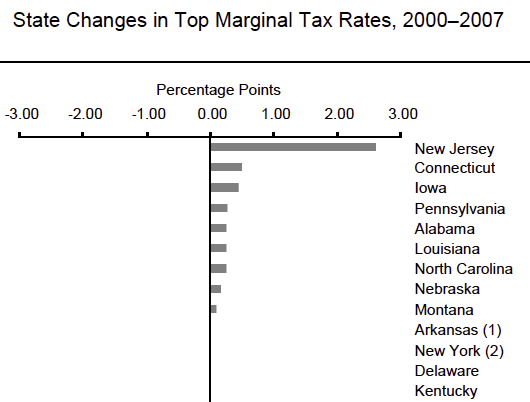
A solid paper by Cristobal Young and Charles Varner, “Millionaire Migration and State Taxation of Top Incomes” (hat tip Matt) helps debunk the idea that high income individuals will pull up stakes if their taxes go up. The case study is an interesting one: New Jersey’s tax increases on top earners. New Jersey made the biggest increase of all US states, and also has the distinction of having a low income tax state (Connecticut) nearby, meaning that tax-sensitive residents had an option of moving not all that far to escape the increase, which presumably would allow them to maintain family ties.

Screen shot 2011-02-09 at 3.16.11 AM

The study results might be labeled “Millionaires are People Too.”

Read more...

The IMF’s Epic Fail on Egypt

Over the last week, we’ve had the spectacle of the Western media speculating about what is going on in Egypt in the absence of much understanding of the forces at work (this article by Paul Amar is a notable exception).

Needless to say, there has also been a great deal of consternation as to how the West’s supposedly vaunted intelligence apparatus failed to see this one coming. This lapse is as bad as the inability to foresee the collapse of the Soviet Union (it’s arguably worse: a lot of people profited from the Cold War, and they’d have every reason to fan fears and thus look for evidence that would support the idea that the USSR was a formidable threat. By contrast, one would think that conveying word that the domestic situation in Egypt was charged would have led to more intense scrutiny which ought to have served some interests (like various consultants and analysts). That suggests the US was so wedded to Mubarak that anyone who dared say his regime was at risk would get “shoot the messenger” treatment, and thus nary a discouraging word was conveyed).

Read more...

Guest Post: Leverage, Inequality, and Crises

By Michael Kumhof, Deputy Division Chief, Modeling Unit, Research Department, IMF and Romain Rancière, Associate Professor of Economics at Paris School of Economics. Cross posted from VoxEU

Of the many origins of the global crisis, one that has received comparatively little attention is income inequality. This column provides a theoretical framework for understanding the connection between inequality, leverage and financial crises. It shows how rising inequality in a climate of rising consumption can lead poorer households to increase their leverage, thereby making a crisis more likely.

The US has experienced two major economic crises during the last century – 1929 and 2008. There is an ongoing debate as to whether both crises share similar origins and features (Eichengreen and O’Rourke 2010). Reinhart and Rogoff (2009) provide and even broader comparison.

One issue that has not attracted much attention is the impact of inequality on the likelihood of crises. In recent work (Kumhof and Ranciere 2010) we focus on two remarkable similarities between the two pre-crisis eras. Both were characterised by a sharp increase in income inequality, and by a similarly sharp increase in household debt leverage. We also propose a theoretical explanation for the linkage between income inequality, high and growing debt leverage, financial fragility, and ultimately financial crises.

Read more...

The Specious Logic of Wall Street Pay

It’s remarkable how Masters of the Universe, the new financial elite first identified by Tom Wolfe in 1986, remember nothing and regret nothing. And why should they? Their position remains remarkably secure 25 years later.

We see the “Who us, take responsibility for our actions?” stance in full view courtesy one of their most effective spokesman, Steve Eckhaus, an attorney who has negotiated many big ticket Wall Street compensation contracts. From the Wall Street Journal:

“It was understandable why there was anger,” says Mr. Eckhaus, but “the crisis was not caused by Wall Street fat cats. It was caused by a confluence of economic, political and historical factors.”..

In general, he said his clients are “pure as the driven snow” and doing work that supports the economy and justifies their pay….

“You have to know what the profits are” to know what someone should make, said Mr. Eckhaus, noting Wall Street’s top performers usually gobble up 80% of the bonus pool. “Those who are responsible for profits should share in the profits in a way that rewards them.””

This is the usual “heads I win, tails you lose” logic. The rationale for bulging pay packets is that the producers created it, therefore they deserved their cut. But Eckhaus says any bad events are due only to bad luck. Sorry to tell you, but only narcissists and their agents take credit for good stuff and lay the blame on everyone else. Unfortunately, we breed for that in Corporate America, it happens to be a very effective career strategy in large organizations.

Read more...

Pete Peterson Using High School Courses As Trojan Horse for Anti-Social Security, Medicare Propaganda

It’s not a pretty spectacle when a very rich man tells little people they ought to get by with less, particularly when his firm benefitted handsomely from the pump and dump operation that led to the financial crisis.

Pete Peterson, one of the two founders of the Blackstone Group, has had a longstanding campaign against Social Security and Medicare. He’s sufficiently aggressive that to combat consistent poll ratings that show that both programs enjoy substantial support, his foundation set out to generate different survey results by stacking the deck heavily in its favor. As we recounted last July:

For those who did not catch wind of it, the Peterson Foundation, which has long had Social Security and Medicare in its crosshairs, held a bizarre set of 19 faux town hall meetings over the previous weekend to scare participants into compliance and then collect the resulting distorted survey data, presumably to use in a wider PR campaign.

Read more...

Croesus Watch: Banker Pay Levitates to New Highs

Oh, I need a new round of black humor as a coping device to deal with the predictable but nevertheless disheartening news that banksters are getting record pay for 2010, after having gotten record pay for 2009…after having wrecked the global economy.

If this isn’t incentivizing destructive behavior, I’d like you to suggest how we could make this picture worse. A newspaper ad for the swaps salesman that tanked the most municipalities? Ticker tape parades for the deal structurer that was best at pulling most fees out of clients in ways they wouldn’t detect? (Oh wait, you’d have to include pretty much every derivative salesman) Honorable mention for the banker with the biggest expense account charges in the industry? (Oh wait, that’s not the right metric, we learned in Inside Job that the drugs and hookers get charged to research budgets. Damn).

My pet joke from the dot bomb era scandals is now looking a bit tired:

Read more...

John Bougearel: Claims the Job Market Will Boom Are Entirely Unsubstantiated

By John Bougearel, author of Riding the Storm Out and Director of Financial and Equity Research for Structural Logic

A decade ago, the Bureau of Labor Statistics predicted that the U.S. economy would create nearly 22 million net jobs in the 2000s.

Obama said with the benefit of his stimulus measures, the US economy would create three million jobs in 2010. The actual number of jobs created in 2011 was 1.12 million (before final benchmark revisions). Now, the CBO is projecting 2.5 million jobs will be created annually from 2011 to 2015.

Faith in the US gov’t’s ability to create 2.5 million jobs for the next 5 yrs (one of the several silly and preposterous CBO projections) is sorely misplaced. The CBO has sugarplums dancing in their heads. Their 2011-2016 forecast for the US jobs market is disingenuous, misleading poppycock.

Read more...